

SYSTEM INTEGRATORS
CONFIGURABLE OPERATOR CONTROLS
FOR MACHINE & EQUIPMENT SYSTEMS
INDUSTRY: System Integrators
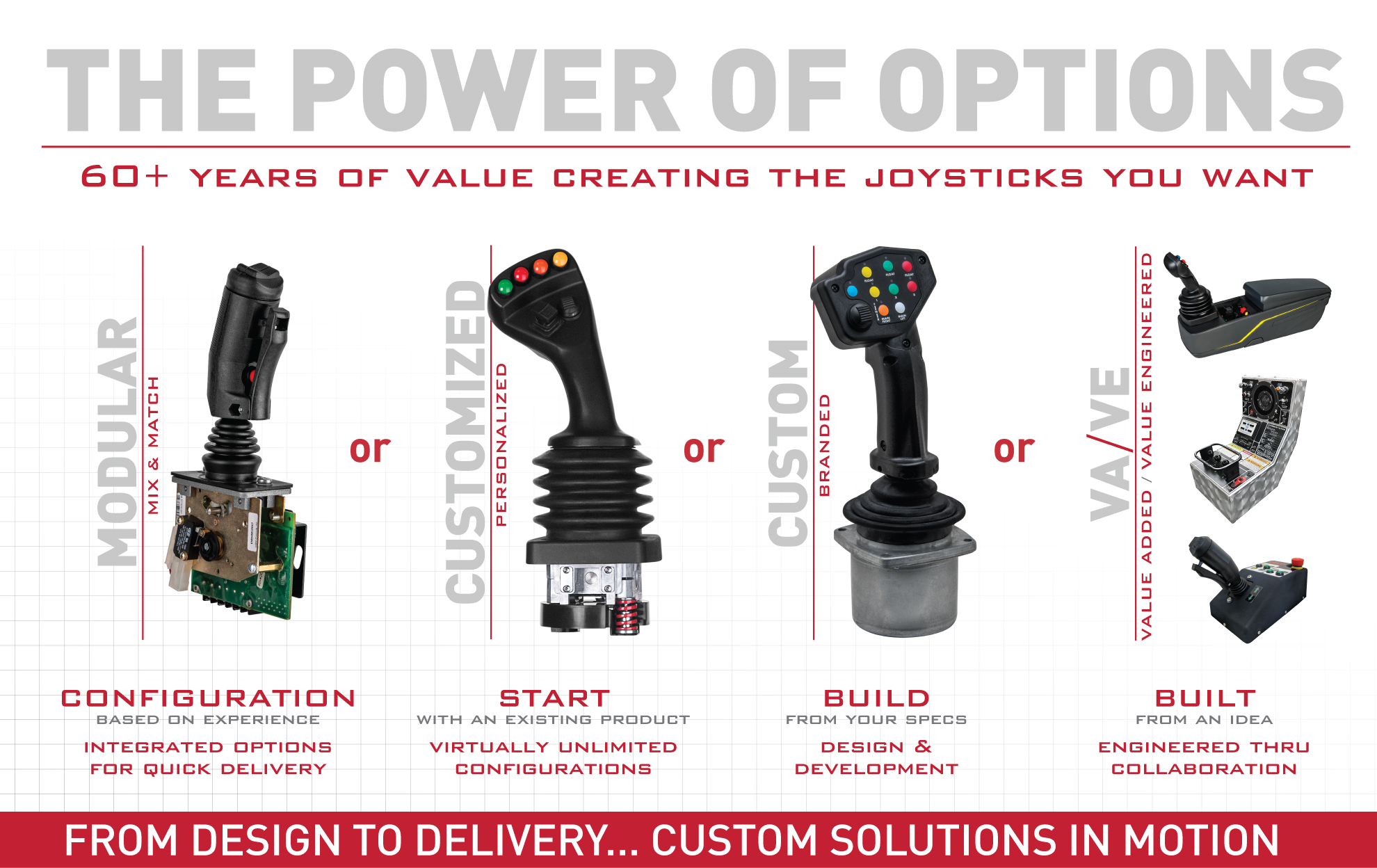
OEM Controls designs and manufactures configurable industrial joystick controllers, handles, switches, pedals, and related control products for mobile and industrial equipment.
System integrators need operator controls that fit the machine, not the other way around.
The starting point is understanding what the operator needs to control, how the control will be used, and what the application requires.
Match The Control To The Application
Different Operator Tasks Call for Different Control Approaches.


Single-Axis Control
When the operator needs to control one primary proportional movement or function, a single-axis controller can provide a focused and straightforward interface.
OEM Controls offers single-axis platforms with a range of available handle, mechanical, electrical, and mounting configurations.
Multi-Axis Control
When multiple movements or functions need to be controlled from one joystick, dual-axis and multi-axis platforms provide additional control within a single operator input.
Available configurations include different handle, gate, mechanical, and electrical options depending on the controller family.
Compact & Auxiliary Control
Compact proportional controllers can provide additional operator input within a grip, armrest, console, panel, or other location where available space is limited.
OEM Controls offers compact Hall-effect controls with different operator-input styles for these applications.
Handle-Mounted Functions
The joystick handle can do more than provide the primary directional input.
Depending on the controller and grip combination, push buttons, rockers, switches, triggers, and other auxiliary inputs can place additional functions within reach of the operator’s primary control.
Engineering The Operator Interface
Controller selection starts with the application and the operator task. Defining these four areas can help narrow the appropriate control platform and configuration.
Control Functions
Start with what the operator needs to accomplish.
Consider the number of controlled functions, number of axes, proportional versus switched inputs, auxiliary commands, and which functions should remain accessible from the primary control.
A straightforward function may call for a single-axis controller. Equipment requiring coordinated movement or multiple functions may be better suited to a dual-axis or multi-axis control.
Operator Interface
The control also needs to fit the way the equipment is operated.
Hand position, control direction and travel, frequency of use, handle functions, spring return, detents, gate pattern, and available operating space can all influence controller selection.
The goal is not simply to provide the required input. It is to configure that input around how the operator interacts with the equipment.
Electrical Requirements
Electrical requirements should be established before the controller configuration is finalized.
OEM Controls offers different electrical configurations across its controller families, including analog, electronic, switching, and CAN-based options on applicable products.
Capabilities vary by controller, so the required output and interface should be evaluated as part of product selection.
Mechanical & Environmental Requirements
The controller must fit both the equipment and its operating environment.
Mounting space and orientation, connector location, temperature, vibration, moisture, dust and dirt exposure, and frequency of operation can all affect which controller is appropriate.
Environmental ratings and mechanical construction vary by product and should be evaluated against the requirements of the application.
Frequently Asked Questions (FAQs)
Explore Solutions For System Integrators
Single- and multi-axis controls for proportional and coordinated machine functions.
Configurable grips and controls for operator-accessible auxiliary functions.
Alternative input devices for switching, selector and specialized control requirements.
Configured Around The Application
The controller family is only the starting point.
OEM Controls platforms offer different combinations of handles, buttons, switches, gates, detents, spring-return characteristics, electrical outputs, mounting arrangements, connectors, and environmental protection.
When a standard configuration doesn’t fully address the application, OEM Controls can help evaluate the requirements and identify available configuration options within the appropriate controller family.