AERIAL WORK PLATFORM
INDUSTRY CONTROLLERS & SOLUTIONS
INDUSTRY: Aerial Work Platform
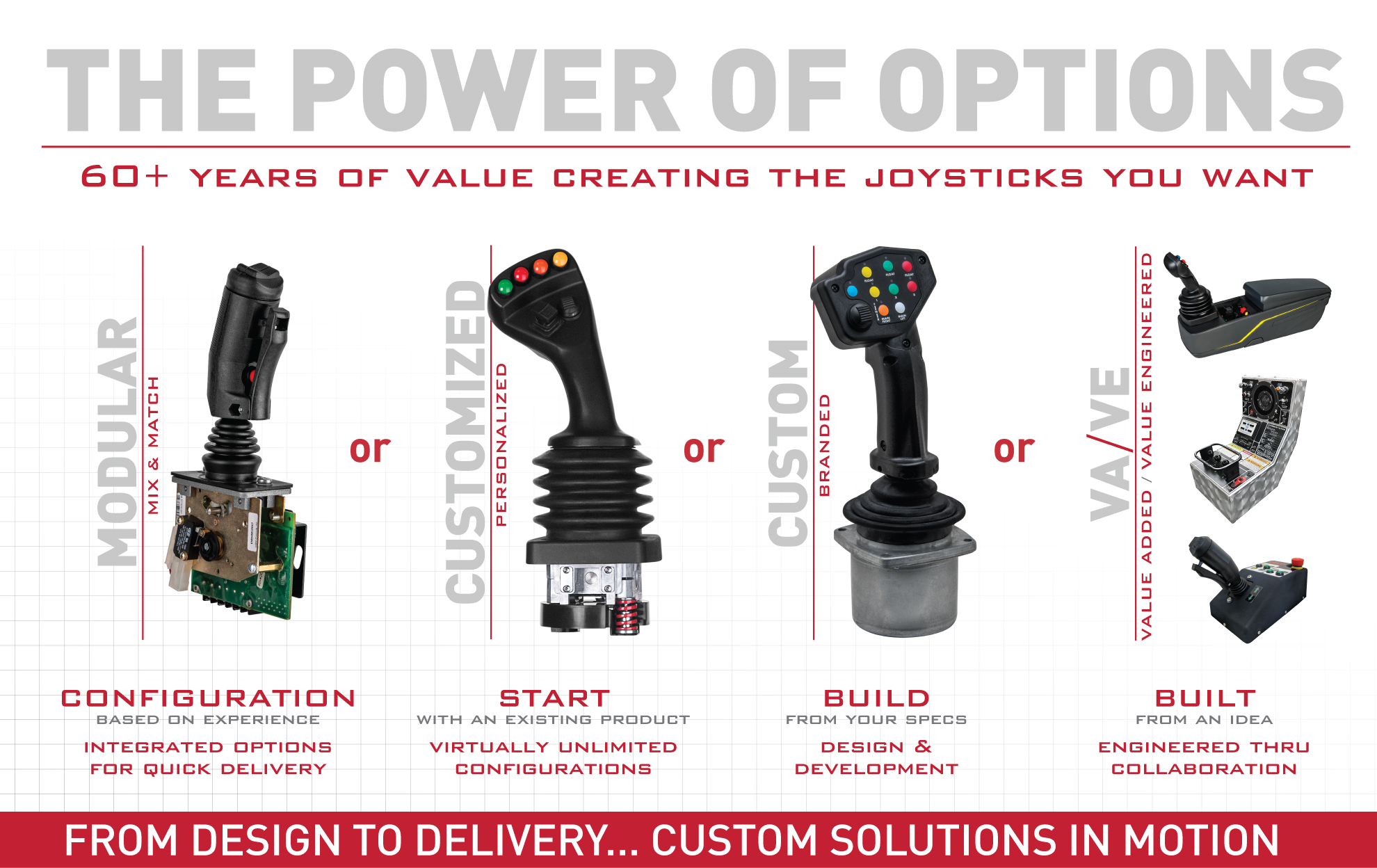
OEM Controls designs and manufactures configurable joystick controllers, handles, switches, foot pedals, electronic modules, and data-delivery products for aerial work platform manufacturers, system integrators, and specialized access-equipment applications.
Aerial work platforms require precise, predictable operator control for lifting, positioning, driving, steering, and performing auxiliary functions at height.
From compact vertical mast and scissor lifts to articulating and telescopic boom platforms, the right control solution should be selected around the machine’s functions, operator requirements, electrical architecture, operating environment, and integration needs.
Aerial Work Platform Applications
Different types of aerial work platforms place different demands on the operator interface. Controller selection should reflect the movements, functions, operating environment, and machine architecture of the specific equipment.


Vertical & Scissor Lifts
Indoor equipment may prioritize precise maneuvering and efficient use of limited operator-panel space, while rough-terrain scissor lifts introduce additional exposure to vibration, dirt, moisture, and outdoor jobsite conditions.
Articulating Boom Lifts
Articulating boom lifts can require coordinated operator input across several machine movements, including boom elevation, articulation, platform positioning, drive, steering, and auxiliary functions.
Telescopic Boom Lifts
Controller configuration should consider axis requirements, proportional response, handle functions, electrical interface, mounting, and the physical layout of the platform controls.
Truck-Mounted & Specialized Access Equipment
These applications may require a control configuration tailored around the equipment’s specific functions, operator interface, packaging constraints, and machine architecture.
Engineering the Operator Interface
Aerial work platform control selection should consider how the operator needs to move the equipment, which functions need to be available simultaneously, and how the controller will integrate with the rest of the machine.
Control Precision
Controller selection should consider mechanical travel, proportional response, axis arrangement, return-to-center behavior, and the amount of modulation the operator needs for each controlled function.
Function Density
Configurable handles can incorporate switches, triggers, thumb controls, and other inputs so frequently used functions can be positioned where they make sense for the application.
Operator Ergonomics
Grip geometry, controller placement, operating force, hand position, and switch accessibility can influence how naturally the operator interacts with the machine during repeated operation.
The operator interface should therefore be evaluated as a complete system rather than selecting individual controls in isolation.
Environmental Requirements
Aerial work platforms may operate indoors, outdoors, on construction sites, or in other demanding environments.
Vibration, dirt, moisture, temperature, exposure, and expected duty cycle should be considered when determining the appropriate controller and configuration.
Frequently Asked Questions (FAQs)

Explore Aerial Work Platform Control Options
Single- and multi-axis controls for proportional and coordinated machine functions.
Configurable grips and controls for operator-accessible auxiliary functions.
Alternative input devices for switching, selector and specialized control requirements.
Build The Control Around The Machine
The right aerial work platform control solution starts with the equipment, operator, and functions that need to be controlled.
OEM Controls can help evaluate the controller, handle configuration, operator inputs, electrical interface, and integration requirements for your application.